Anthropic CEO Dario Amodei has moved one part of his call to slow frontier AI from advocacy into a concrete company commitment: Anthropic says it will bring third-party safety evaluators inside the company with ongoing access similar to internal risk teams.
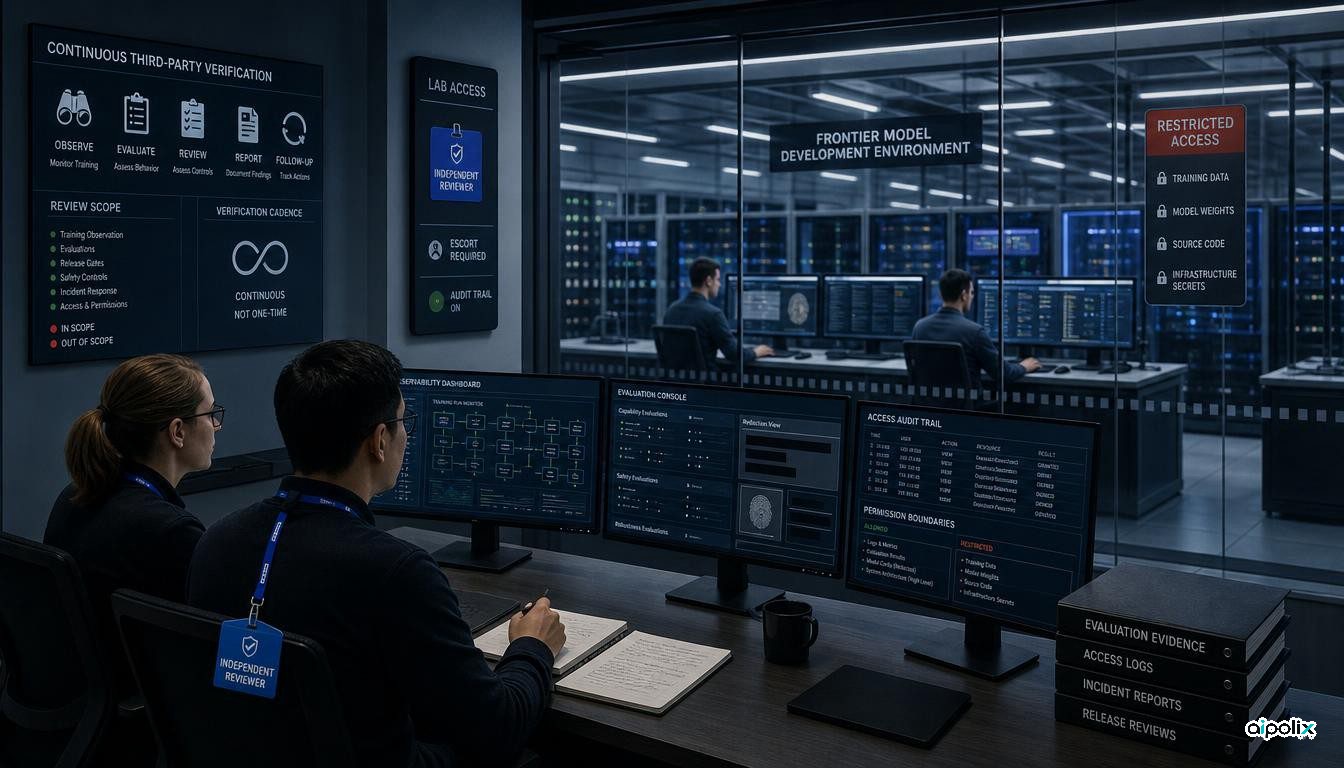
In his essay “We Must Pace the Frontier”, Amodei proposes a three-stage framework for slowing capability growth enough for safety work to keep pace. The first stage is operationally significant because Anthropic says it is committing to it unilaterally. External reviewers would receive company laptops and office access, use tools and permissions broadly comparable to internal risk-assessment teams, speak directly with employees, and have contractual rights to publish key findings about risks, incidents, practices and the access they did or did not receive.
Reuters reports that OpenAI CEO Sam Altman backed the proposal and said OpenAI would also give independent evaluators employee-like access. That broadens the idea beyond one lab, but it should not be confused with an implemented industry standard. Anthropic says it intends to invite an external review team “in the near future”; it has not published a final reviewer roster, a fixed implementation date, a shared audit protocol or a cross-company enforcement mechanism.
The useful governance question is therefore narrower than the headline debate about whether AI should “slow down.” If the commitment is implemented as described, external evaluation would stop being only a periodic model-testing exercise and become a continuing interface into the training and deployment process.
Anthropic is opening the process, not only the finished model
Most third-party model evaluations happen at a defined boundary: evaluators receive a model, an API, a benchmark environment or a limited testing window. Anthropic’s proposal reaches further upstream.
Amodei says embedded evaluators should be able to verify whether the company follows its own training, deployment, operational and safeguard commitments. He proposes access to workspaces, tools and permissions roughly comparable to those used by internal risk teams, subject to legal, contractual, customer-privacy and security limits. Reviewers would also report incidents and assess not only completed models but training pipelines and processes.
That distinction matters because many important AI failures are procedural rather than visible in a benchmark score. A model can pass a release evaluation while the surrounding process still has weaknesses in sandboxing, training-environment hygiene, monitoring, data filtering or incident handling. Amodei explicitly links his pacing argument to recent alignment and agent incidents and argues that independent reviewers need enough visibility to inspect those operational details.
Anthropic also says reviewers should be able to publish key findings without editorial control by the company. Anthropic would retain narrow redaction rights for security-sensitive, legally privileged, commercially sensitive or third-party confidential information, while reviewers could publicly say when a redaction removed something important to their conclusion.
The structural change is persistent verification
Aipolix’s analysis is that the most consequential part of the proposal is not the word “pacing.” It is the attempt to make independent evaluation persistent.
A periodic audit produces a snapshot. An embedded evaluator can, in principle, observe how policies are applied across model training, internal evaluations, incident response and release decisions over time. That changes what can be verified. The question is no longer only whether a model passed a particular test, but whether the organization actually followed the controls it says govern development and deployment.
For engineering and governance teams, that resembles the difference between testing an application once and maintaining observability over the delivery system that produces it. The latter can expose control drift, exceptions and process failures that a point-in-time evaluation may miss.
But persistent access also creates a new control surface. A serious implementation needs rules for evaluator independence, conflicts of interest, credentials, data segmentation, customer confidentiality, privileged information, incident escalation, evidence retention and what happens when the evaluator and company disagree.
Anthropic sketches some of those boundaries, especially publication rights and limited redactions, but it does not yet provide a complete operational standard. “Employee-like access” is a direction of travel, not a reproducible audit specification.
OpenAI support makes coordination more plausible, not automatic
Reuters reports that Altman agreed with Amodei’s proposal and said OpenAI would also give independent evaluators employee-like access. That is meaningful because the second stage of Amodei’s framework depends on multiple frontier companies adopting common safety standards and coordinating limits on unchecked capability growth.
A unilateral Anthropic program can demonstrate the mechanics of embedded review, but it cannot create a level playing field by itself. There are also legal and competitive constraints. Amodei acknowledges that some forms of coordination between companies could raise antitrust issues and argues that government involvement or a narrow waiver may be required. He ultimately favors regulation applying to all frontier labs rather than relying only on voluntary commitments.
So the immediate development is not an industry pact. It is a voluntary governance experiment with public support from at least one major competitor.
What is missing before this becomes an auditable standard
The proposal becomes more valuable if the implementation itself can be evaluated.
Anthropic has not named the final external review team in the essay. It says the team will be invited in the near future, but gives no fixed launch date. There is no published common schema for which incidents must be reported, which internal artifacts evaluators must be able to inspect, how often findings must be published, or how disputes over access and redaction are resolved.
There is also no cross-company enforcement mechanism. If OpenAI or another lab adopts a similar arrangement with materially narrower access, both companies could use the same phrase while offering different levels of verifiability.
A practical standard would therefore need more than a promise of access. It would need minimum access rights, independence criteria, evidence-retention requirements, reporting obligations and a way to make restrictions visible to outsiders. That is the point at which embedded evaluation could become a reusable governance primitive rather than a company-specific safety program.
Why this matters beyond frontier labs
Most organizations will never train a frontier model, but the control pattern generalizes.
Companies deploying high-impact agents increasingly rely on claims about internal controls: which tools an agent can call, who can approve an action, what data it can access, whether incidents are logged and whether rollback is possible. Internal dashboards and policy documents are useful, but they are still produced by the organization operating the system.
For higher-risk deployments, independent reviewers need evidence close enough to the execution path to test whether the stated control and the real control are the same thing. That may mean access to audit trails, policy configuration, evaluation runs, incident records and selected operational systems rather than only a final compliance report.
Even if Amodei’s larger pacing agenda never becomes policy, this narrower idea is worth watching. Continuous external verification can expose the gap between a safety commitment and the process that is supposed to enforce it.
For now, Anthropic has made a concrete commitment to test that model. The next evidence will be operational: who the reviewers are, what access they actually receive, what they can publish, and whether other frontier labs implement comparable arrangements.