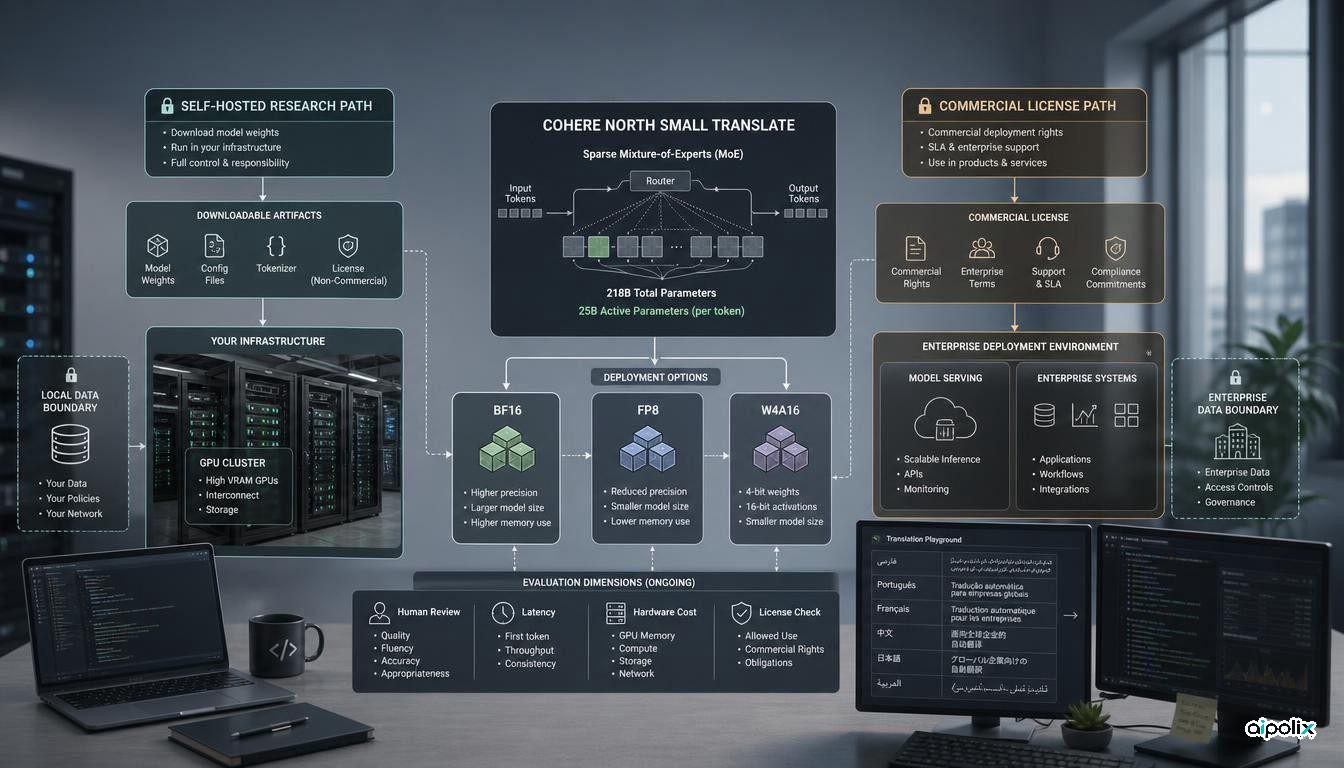
Cohere has released North Small Translate, a translation-focused mixture-of-experts model whose weights can be downloaded and run outside Cohere’s hosted service. The model has 218 billion total parameters, activates 25 billion per token, supports 50 languages, and provides 16K input and output context. Cohere offers BF16, FP8 and NVFP4 W4A16 checkpoints, alongside API access.
The important qualification is in the license. The downloadable weights are governed by CC BY-NC 4.0 plus Cohere Labs’ acceptable-use terms. That makes the release useful for research, evaluation and non-commercial deployment, but it does not give a product team unrestricted commercial rights. Cohere directs commercial users to a separate license and Model Vault.
The weights are downloadable, but the commercial right is separate
“Open weights” can describe a technically inspectable and self-hostable model without meaning that every use is permitted. North Small Translate is a clear example. Researchers can obtain the weights from Hugging Face, inspect the model card and run the model on their own infrastructure after accepting the repository conditions. Cohere’s documentation, however, explicitly marks the public license as non-commercial.
For procurement and architecture teams, this distinction matters as much as benchmark quality. A company cannot infer from the availability of model files that it may embed them in a revenue-generating product, redistribute a derivative, or operate them for a commercial workload under the public license. Those rights have to be checked against the commercial agreement Cohere offers separately.
Aipolix’s view is that “sovereign” deployment therefore has two independent dimensions here: technical control over where inference runs, and legal control over what the license permits. Self-hosting can improve data locality and operational control, but it does not remove licensing constraints.
Twenty-five billion active parameters still requires serious hardware
North Small Translate uses a sparse mixture-of-experts architecture with 218 billion parameters in total and 25 billion active parameters. The model card says it has 128 experts, with eight selected per token plus shared experts.
The active-parameter number can make the model sound relatively small, but the deployment footprint remains substantial. Cohere lists eight H100 GPUs or four B200 GPUs for the BF16 checkpoint, four H100s or two B200s for FP8, and two H100s or one B200 for the NVFP4 W4A16 variant. The W4A16 model card says quantization reduces the model footprint from roughly 437 GB to 131 GB while leaving attention projections, routers and the output head at higher precision.
That makes the release self-hostable for organizations with modern accelerator capacity, not a lightweight local model for ordinary developer hardware. Teams comparing it with API translation services should include GPU acquisition or rental, serving utilization, concurrency and operational overhead rather than comparing only model-quality scores.
The headline benchmark lead is still a vendor-run result
Cohere reports an 83.60 score across its WMT26 all-language evaluation and 84.36 for an “Agentic” multi-pass workflow that can identify and correct translation errors. The launch post compares those numbers with DeepL, Google Translate and several open-weight language models. It also reports higher throughput than Gemma 4 31B in Cohere’s internal serving tests and a strong long-document score.
Those numbers are useful release evidence, but they are not independent validation. Cohere says the WMT26 comparison uses GPT-5.6-Sol as a judge, while the long-context evaluation uses xCOMET-XL paragraph scoring. The launch material does not provide an independently reproduced human quality assessment covering every supported language.
That matters especially for translation. Aggregate scores can hide large differences by language pair, domain, terminology and document type. A model that performs well on average can still fail on legal phrasing, product terminology, named entities, formatting or a lower-resource language important to one customer.
The practical implication is straightforward: treat Cohere’s benchmark table as a reason to test the model, not as a purchasing conclusion. A production evaluation should include bilingual human review for the actual language pairs and documents that matter to the organization.
Agentic translation changes what should be measured
The higher-scoring Agentic mode is also important because it changes the unit being compared. Cohere describes it as a workflow that can find and fix translation errors rather than a single ordinary generation pass.
The release post gives the quality score for that workflow, but it does not present an equivalent end-to-end latency and cost comparison for the Agentic mode alongside the standard model. Teams therefore need to measure the whole task: how many passes are performed, how much extra generation is used, how latency changes, and whether the quality gain survives human review.
This is a broader lesson for model benchmarks. Once an “agentic” workflow performs revision or verification around a model, the benchmark no longer measures only the base model. It measures a system. That system may be better, but its operational cost and failure modes need to be evaluated as part of the same claim.
The model supports Persian and Portuguese, but support is not a quality guarantee
The model card lists 50 supported languages, including Persian, Portuguese and French as well as languages across Europe, South and Southeast Asia, and East Asia. That breadth makes the release relevant to multilingual products that want to keep translation on controlled infrastructure.
Language presence on a support list should not be confused with demonstrated parity, however. Cohere publishes regional averages and aggregate benchmark results, not a complete independent human-quality report for every language pair. For a team serving Persian or European Portuguese users, the correct acceptance test is native editorial review on real material, including terminology, register, punctuation, bidirectional text where relevant and preservation of structured content.
This is particularly important for long documents. Cohere’s 16K input and output context makes larger translation units possible, but consistency across sections, references and terminology should be tested directly rather than inferred from context length.
North Small Translate is useful precisely because its constraints are visible
The release gives developers something concrete to evaluate: downloadable checkpoints, documented quantizations, known hardware targets and a model specialized for translation rather than general chat. That is more actionable than a translation feature available only behind an opaque endpoint.
The strongest reason to test North Small Translate is therefore not the claim that it beats every incumbent. It is that teams can evaluate the same model across hosted and self-managed paths while seeing the architecture, deployment requirements and licensing boundary in advance.
For commercial deployment, three decisions should remain separate: whether the model is accurate enough for the organization’s language pairs, whether its serving footprint is economically sensible, and whether the chosen license grants the intended rights. North Small Translate makes the first two technically testable and the third unusually explicit. None of them should be collapsed into the single label “open weights.”