Cursor has extended its coding-agent strategy beyond code generation and pull-request creation into two operational control points that usually remain human-heavy: deployment monitoring and security review. The company released Rollouts and Security Review on September 23 for Teams and Enterprise customers. The important change is not another coding assistant feature. It is the attempt to put software agents directly into the feedback loops that decide whether a change is safe to ship and whether it remains healthy after deployment.
Rollouts moves the agent boundary past the pull request
Rollouts attaches monitoring to each pull request and follows the change as it reaches configured environments. Cursor says the bot reads the diff and the systems affected, writes a monitoring plan, and then uses connected deployment and telemetry systems to classify the change as verified healthy, regression detected, or inconclusive.
That architecture matters because most coding agents still stop at a repository boundary. They can propose code, run tests and open a pull request, but production truth lives elsewhere: deployment systems, metrics, logs, traces and incident signals. Rollouts is an attempt to connect those operational signals back to the unit of change.
The useful design detail is the “inconclusive” state. A deployment agent that is forced into a binary healthy/unhealthy answer can create false confidence when observability is incomplete. Explicitly representing uncertainty gives teams a place to distinguish a clean deployment from a deployment that simply lacks enough instrumentation to judge.
Security Review turns review into an attack-path problem
Security Review runs on pull requests and looks for exploitable issues rather than only style or generic static-analysis warnings. Cursor lists SQL, command and template injection, authorization and authentication bypasses, committed secrets, SSRF, unsafe deserialization, unvalidated redirects, vulnerable dependency changes and insecure infrastructure defaults among the classes it checks.
Each finding includes severity, an attack path and a suggested fix. Teams can also define codebase-specific rules. That combination pushes the product toward contextual security review: the agent must reason about how user-controlled input reaches a sensitive operation, not merely match a suspicious line.
This does not make the bot a replacement for SAST, dependency scanning, penetration testing or human security review. Cursor has not published evidence here establishing broad detection or false-positive performance across representative codebases. The stronger interpretation is that Security Review adds an agentic reasoning layer inside the pull-request workflow.
The real product is a closed operational loop
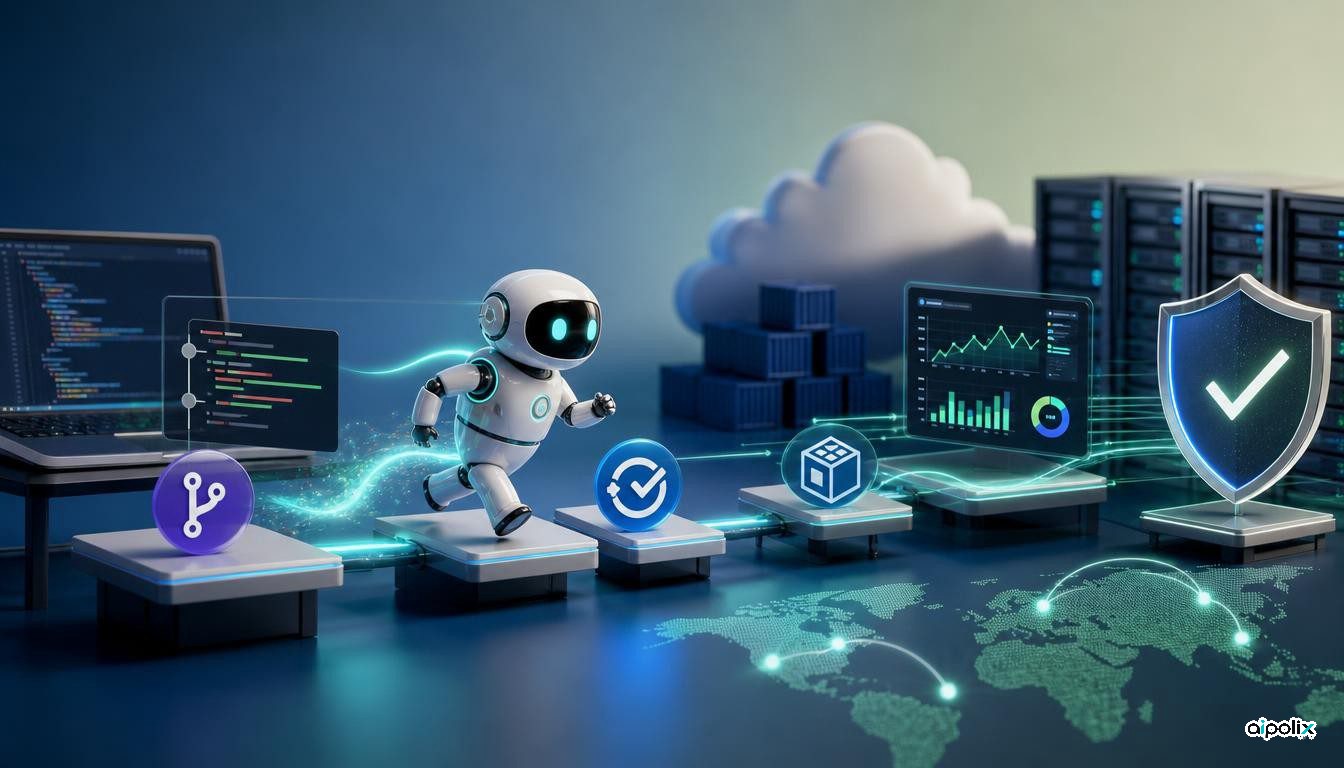
Taken together, the two bots reveal a larger product direction. Coding agents are moving from “produce a patch” toward “own a bounded software-delivery outcome.” A change can now be generated by an agent, checked for exploitable paths, deployed through existing systems, and observed against production telemetry.
That changes the control boundary for engineering organizations. The key integration surface is no longer only Git. It includes source control, deployment infrastructure, observability providers and security policy. Those connections are powerful, but they also enlarge the permissions and evidence surface that teams must govern.
For platform teams, this suggests a practical requirement: agent permissions should be separated by phase. A code-writing agent does not automatically need the same credentials as a deployment-monitoring bot, and a monitoring bot does not need unrestricted remediation authority. Least privilege, auditable actions and explicit rollback limits become more important as automation crosses repository boundaries.
What teams should evaluate before trusting it
The first question is evidence quality. Rollouts can only judge what its telemetry exposes. Missing traces, noisy alerts or weak service ownership can turn an automated verdict into an “inconclusive” result—or worse, a misleading healthy signal if the monitored indicators do not capture the failure mode.
The second question is remediation authority. Cursor says Rollouts can flag regressions and its product material describes acting to restore a healthy state. Teams should determine exactly which actions are enabled in their configuration, what approval gates exist, and how every action is logged before granting production privileges.
The third question is security-review calibration. An attack-path explanation is useful, but teams still need to measure recall, precision and developer acceptance against their own vulnerability history. A one-click fix should be treated as a proposed patch, not proof that the underlying security condition has been resolved.
Aipolix analysis: observability becomes part of the agent contract
The most consequential implication is that observability is becoming an input to software agents, not merely a dashboard for humans. Once an agent is expected to decide whether a deployment is healthy, telemetry quality becomes part of the agent’s effective specification.
That creates a new failure mode: an agent may behave correctly against incomplete evidence and still make the wrong operational decision. The engineering response is not simply a better model. Teams need explicit confidence states, instrumentation coverage checks, permission boundaries and human escalation paths.
Cursor’s release is therefore notable less for adding two bots than for moving the agentic software lifecycle into production operations and security. If this pattern holds, the competitive frontier in coding agents will increasingly depend on how safely they connect code changes to real operational evidence.