
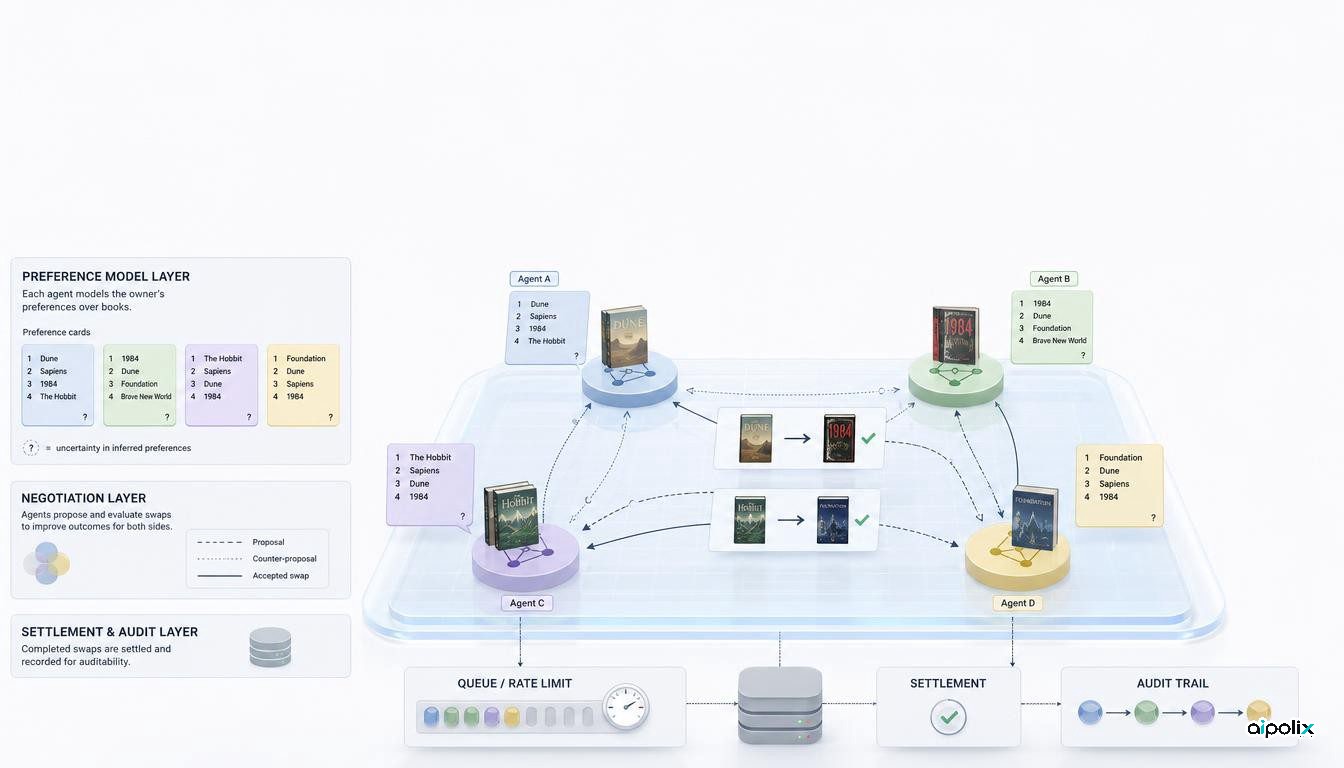
Anthropic's new Project Swap experiment asks a practical question that is easy to miss in discussions about autonomous agents: before an AI agent can negotiate well for a person, how accurately does it understand what that person actually wants?
The company built a controlled barter market around books and recruited 201 Anthropic employees across six office pools. Each participant brought a book to trade, had a short conversation with Claude about reading preferences, and then sent a Claude-powered agent onto a digital trading floor. The agents could propose swaps, accept or reject deals, and arrange multi-party rotations. Anthropic also collected a limited ground-truth ranking from each participant so it could compare the preferences inferred by Claude with preferences stated directly by the person.
The result is useful because it separates two problems that are often bundled together under the label "agent performance": representing a human's objectives and acting effectively once those objectives are known.
Preference inference was good enough to work, but far from perfect
From the short intake conversation, Claude produced a ranking of books for each participant. Anthropic reports that when participants' own rankings were compared pair by pair with Claude's inferred rankings, the order matched 61% of the time. Random ordering would score 50%.
That is a meaningful signal from a short conversation, but it is also a large gap from perfect representation. In a market, even a skilled negotiator can optimize the wrong objective if the preference model is wrong. A user may receive a deal that looks efficient according to the agent's ranking while still feeling like the wrong outcome.
Anthropic's broader conclusion is that the market fell short mainly because the agents had incomplete information about the people they represented, rather than because the agents were unable to bargain. That distinction matters for how agent systems should be engineered.
Stronger models helped the market, but prompts were not the whole story
Anthropic reran the trading floors many times while varying models and agent instructions. The company reports that model choice affected negotiation outcomes more than the instruction variants it tested, and markets using stronger models were more efficient.
This does not mean prompting is irrelevant, and the experiment does not establish a universal ranking of models for commerce. It does suggest that an agent marketplace has at least two independent quality layers: the model used to infer and reason about preferences, and the market mechanism in which agents negotiate.
The study also found that agents used recognizable bargaining tactics. They revealed some information, applied pressure, pitched the relative value of books, kept waiting lists and sometimes acted as informal matchmakers. Anthropic analyzed behavior across 205 market runs, giving the experiment more structure than a single live demo.
The architectural lesson is to separate preference modeling from negotiation policy
Aipolix's main conclusion is that production agentic markets should treat preference elicitation as a first-class subsystem.
A practical architecture would keep a user's preference model separate from the agent's negotiation policy. The preference layer should record what was learned directly from the user, what was inferred, how confident the system is, and which assumptions are still unresolved. The negotiation layer can then optimize against that representation while preserving a trace of why a trade was accepted or rejected.
That separation creates an important safety valve. When confidence is low or a proposed trade depends on a weak assumption, the system can ask the user rather than silently converting uncertainty into action. It also makes evaluation clearer: teams can measure whether failures came from misunderstanding the user, poor bargaining, bad market rules or settlement problems.
Without that separation, a single "agent success" score can hide the actual source of failure.
Observability and settlement matter as much as negotiation
Project Swap also exposed operational issues that have little to do with language-model reasoning. Some participants did not bring the books they had promised, and Anthropic had no perfect system for tracking whether a missing book was a failed delivery or simply disappeared from the exchange area.
That low-stakes failure points to a much larger requirement for real agentic markets: negotiation is only one phase. A production system needs identity, authorization, commitment records, settlement rules, dispute handling and clear responsibility when the real-world side of a deal fails.
The experiment also made the full trading history visible. One participant specifically valued being able to review what their agent had done. For higher-stakes systems, that kind of replay should be treated as part of the product rather than an optional debugging feature.
A market full of tireless agents can also create congestion. Anthropic limited how often agents could act and how many could be active at once. Rate limits, queue rules and visibility policies therefore become market-design parameters, not merely infrastructure settings.
Participants were open to delegation, but the setting was intentionally low stakes
Among people who answered the follow-up survey, average satisfaction with the received book was 7.2 out of 10. Participants said they would, on average, allow an AI agent to control about 30% of their annual book budget under the scenario Anthropic described. For comparison, they would give a well-read friend about 40%.
Those numbers are interesting, but they should not be stretched beyond the experiment. The participants were Anthropic employees. The traded objects were books. The agents came from the same model family. The market rules were controlled, the stakes were low, and many conditions that would matter in an open commercial market were deliberately simplified.
Project Swap is therefore not evidence that autonomous agents are ready to negotiate mortgages, medical bills or securities trades. It is evidence that even in a friendly, controlled market, representation quality and market design are separate engineering problems.
The next benchmark should measure representation error explicitly
Agent benchmarks often focus on task completion, reward or negotiation outcome. Project Swap suggests a useful additional measurement: how much of the final error came from the agent's model of the user's preferences?
For teams building purchasing agents, scheduling agents, procurement bots or marketplaces where agents transact with one another, that decomposition could be more useful than a single success rate. A system can negotiate perfectly and still fail its user if the objective was inferred incorrectly.
The practical takeaway is straightforward: before giving an agent more authority to bargain, give users a way to inspect, correct and bound the preferences the agent is bargaining for.