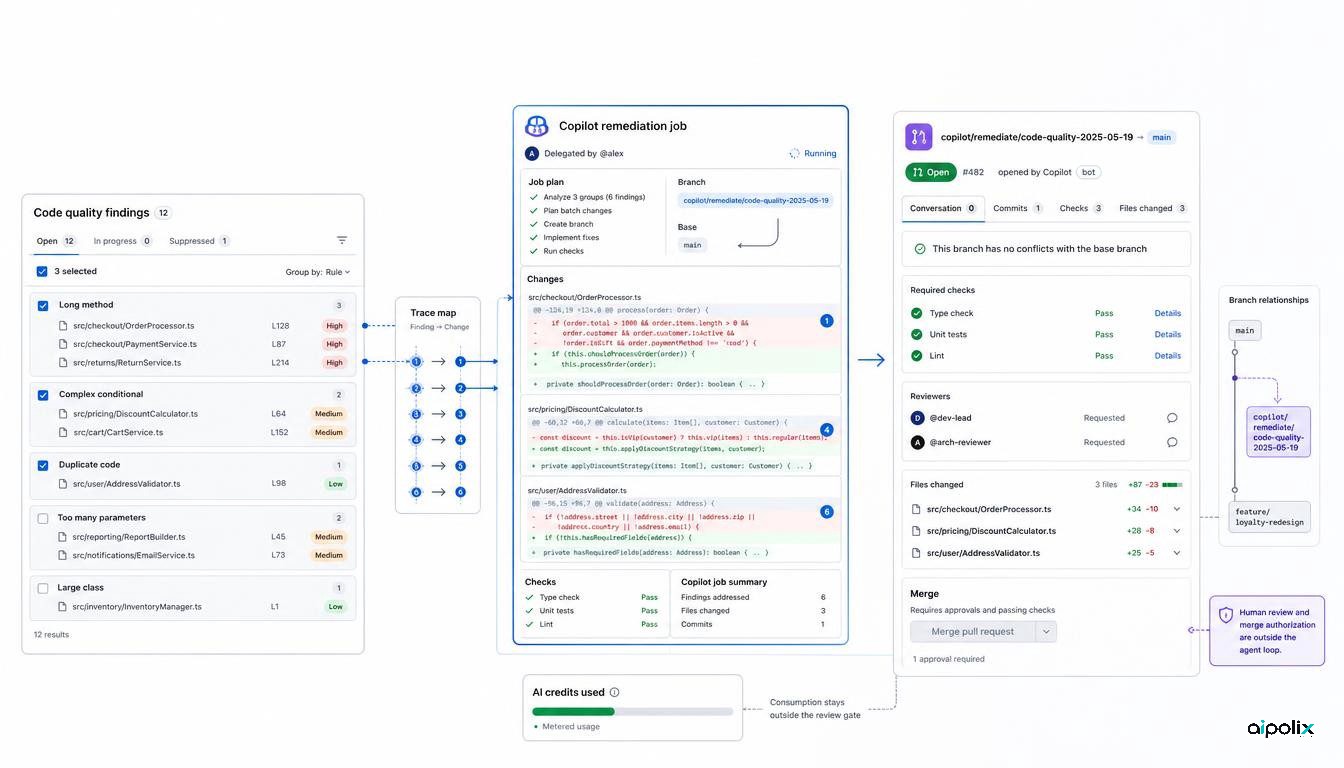
GitHub has added bulk agentic autofix to GitHub Code Quality. Teams can select up to 25 standard findings on one page and assign the set to Copilot in a single action. Copilot works on a branch, validates its changes and opens a pull request for a human to review and merge.
The important change is not simply faster fix generation. Code-quality debt can now be delegated as a batch of work. That shifts the control point from producing a suggestion to reviewing, testing and authorizing a larger set of agent-generated changes.
One assignment can become a multi-finding remediation job
GitHub says Assign to Copilot replaces the previous Generate fix flow for individual findings. A user can select between one and 25 standard Code Quality findings and send them to the Copilot cloud agent. GitHub's Code Quality documentation describes the broader product as scanning the default branch for maintainability and reliability issues and allowing remediation work to be assigned to Copilot.
The operational unit therefore changes. Instead of one finding producing one proposed fix, the agent may interpret several findings, change several files, validate the result and return one pull request. For teams with large backlogs, that can turn static findings into an executable work queue.
Existing policy applies, but acceptance should remain separate
GitHub says bulk agentic autofix follows the existing enterprise policy for Code Quality. There is no separate policy switch for the batch workflow. The company also says assignments consume AI credits.
That is convenient administratively, but permission to use Code Quality is not automatically the same governance decision as permission to create many code changes. The agent's own validation should also not be treated as independent acceptance.
The pull request remains the useful boundary. Branch protection, required tests, code-owner rules and human approval can stay outside the agent loop even when Copilot is allowed to create the branch and propose the changes.
Batch size introduces correlated-change risk
A single poor automated fix is usually local. A batch can create correlated errors if several findings touch the same abstraction, configuration, generated code or test logic.
The Aipolix analysis is that teams should review the batch as a delegated job, not as 25 unrelated successes. The review record should preserve which original finding led to which edit, which files changed, what tests ran and whether one fix altered the assumptions behind another.
This is a familiar automation effect: higher throughput can increase the blast radius of one mistaken assumption. A large pull request without finding-to-change traceability makes that risk harder to diagnose.
AI credits make backlog cleanup an allocation decision
Because Copilot assignments consume AI credits, code-quality remediation now competes with other agent uses such as feature work, security tasks and review.
A large backlog should not automatically become a large agent queue just because bulk assignment is available. Teams can prioritize by risk and expected review cost, then measure accepted fixes per credit and per reviewer hour. If generated pull requests require substantial rework, assignment volume will overstate the value of the workflow.
Availability is broad but conditional
GitHub says bulk agentic autofix is available for repositories with GitHub Code Quality enabled on GitHub Team and GitHub Enterprise Cloud, including Enterprise Cloud with data residency. The Copilot cloud agent must also be available for the repository.
That scope supports staged rollout. Organizations can test the workflow on selected repositories while keeping their existing merge controls intact.
What teams should measure
The useful question is not whether Copilot can process 25 findings in one request. Teams should measure how many findings are actually resolved, regressions introduced, review time, test coverage, edits outside the intended scope, AI-credit consumption and how often reviewers split or reject the batch.
GitHub is moving Code Quality from isolated suggestions toward delegated remediation work. The capacity gain is real, but acceptance, merge authority and cost accountability should remain outside the agent's own decision loop.