
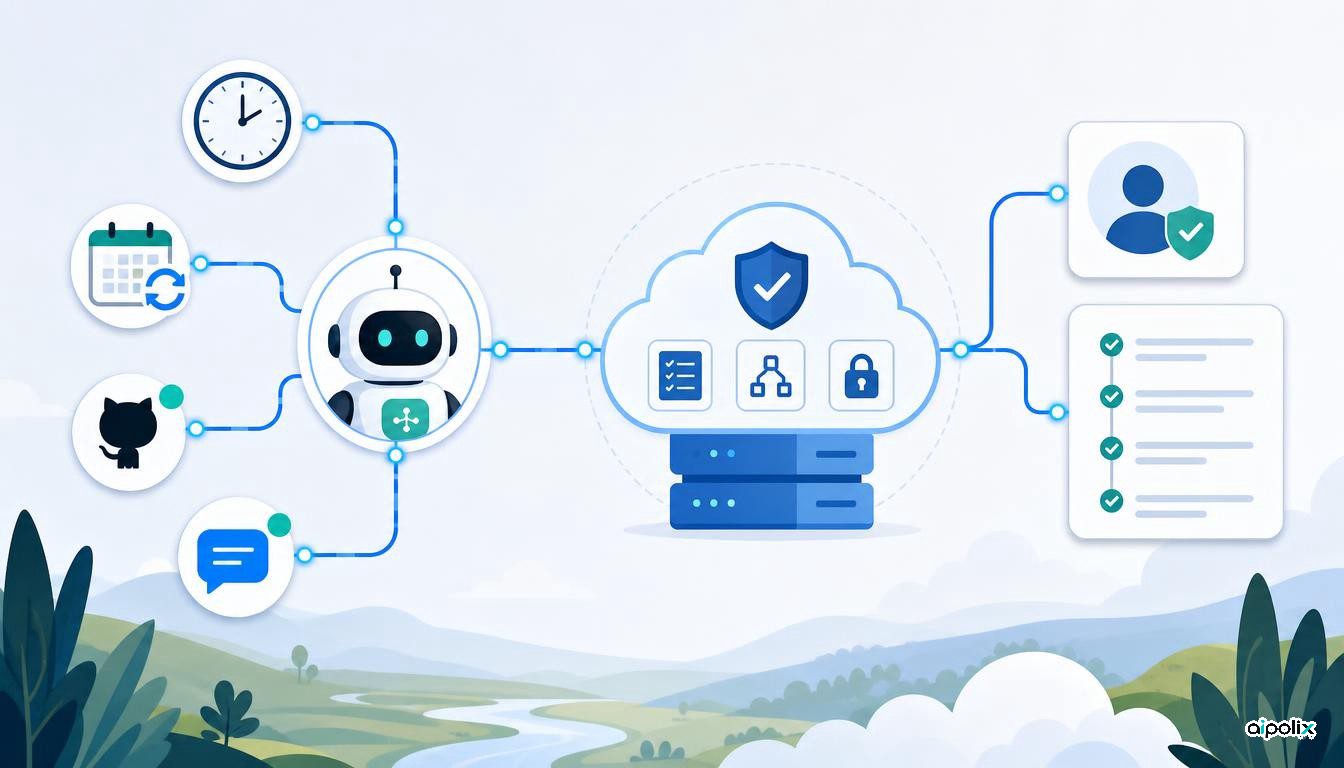
Microsoft has moved Routines in Foundry Agent Service to general availability, turning a piece of agent infrastructure that teams often build themselves into a managed platform feature. Routines can start an agent once at a future time, repeatedly on a schedule, or when an external event arrives. Microsoft also ties the trigger to the agent action, connections, selected identity and execution history inside the same Foundry project.
That sounds like scheduling, but the larger change is architectural. A useful autonomous agent needs more than a model and tools. It needs something to notice when work happens, authenticate to the right systems, invoke the agent reliably, preserve enough context, and leave an audit trail. By moving those responsibilities into Foundry Agent Service, Microsoft is making the control plane around an agent part of the product rather than an application-specific collection of cron jobs, queues and webhook handlers.
Three trigger modes cover the common automation patterns
The GA release supports timer, recurring and event-based routines. A timer can run once at a future date and time. A recurring routine can run on a schedule, such as a weekday report or a compliance check. Event-based routines react to changes in connected systems.
Microsoft's initial event examples include a GitHub issue being opened or assigned and a new message arriving in a Microsoft Teams channel. In those cases, Foundry receives the event through the configured connection, forwards the payload to the agent and records the resulting execution. The agent can then reason over the event, call its tools and take an action without waiting for a person to open a chat.
This closes an important gap between an agent that can perform a task and an agent that can be operated as part of a business process. A coding agent that knows how to triage issues is not automated until something watches for the issue, authenticates to GitHub, delivers the event and records what happened. Routines package that surrounding machinery with the agent configuration.
Identity becomes part of the automation definition
The more consequential detail is identity. Microsoft says routines can invoke the agent and its tools using either the routine creator's identity or the agent's own identity.
Creator identity keeps the automation inside a person's delegated permissions and is appropriate when tools are configured around user OAuth. Agent identity lets the routine operate as an independent service principal with its own Microsoft Entra permissions when the connected tools support that model.
That choice is not cosmetic. It determines which data the automation can read and which actions it can perform when no person is present. A scheduled report and an event-driven remediation bot may use the same model but require very different access boundaries.
For engineering teams, the practical implication is that identity should be reviewed with the trigger and action, not after the agent is built. A routine that wakes every morning to summarize activity may need broad read access but no write access. A routine reacting to an operational alert may need a narrow set of write permissions, approval gates and a complete action log. Managed scheduling reduces infrastructure work; it does not remove the need for least privilege.
The reminder tool adds continuation, not just triggering
The announcement also describes a reminder tool, currently in preview, for hosted agents that need to continue work later. An agent can start a long-running task, schedule itself to run again after a delay, return to the same conversation and check whether the work has finished.
This is different from an external schedule. A routine says when the environment should start the agent. A reminder lets the agent decide that its own task is not finished and arrange a later continuation. Together, the two mechanisms support workflows such as waiting for an export, checking a deployment, or returning after an approval window without requiring a separate polling service.
The distinction matters for stateful automation. If the platform can preserve the conversation and resume the same agent, developers can avoid rebuilding some of the state-management layer that normally surrounds asynchronous work.
Aipolix analysis: the scheduler is becoming part of the agent control plane
The strongest implication of the release is that agent platforms are absorbing infrastructure that used to sit outside the agent runtime. Scheduling, event intake, identity, connections and run history are converging into one managed control surface.
That can make production systems simpler because the team has fewer independent components to deploy and monitor. It can also make governance clearer: an administrator can reason about what wakes an agent, which identity it uses and what executions occurred from one platform.
But consolidation also changes where teams must ask hard reliability questions. Microsoft's announcement says Foundry queues routine invocations and records results, but it does not define every delivery guarantee or retry semantic in the announcement itself. Before using a routine for irreversible actions such as deleting data, changing access or triggering financial operations, teams should verify how duplicate events, retries, partial failures and replay are handled in the exact configuration they deploy.
That is the hidden operational boundary. A model may choose the correct action and still produce a bad outcome if the same event is delivered twice or if a tool call succeeds before the surrounding run is retried. Idempotent tool design, narrow permissions and explicit approval rules remain application responsibilities even when the scheduling layer is managed.
Why GA matters
Routines existed in preview before this release, so the novelty is not that Foundry can schedule an agent at all. The material delta is that Microsoft is now presenting this automation layer as generally available infrastructure for production use.
For organizations already using Foundry Agent Service, that can remove a class of glue services from the architecture. Instead of pairing every agent with a separate scheduler, webhook receiver, queue and run-history store, teams can start with a managed routine and add custom infrastructure only where their workflow needs stronger guarantees or specialized control.
The broader direction is clear: enterprise agent platforms are moving from "host a model with tools" toward "operate a long-running software actor." Once triggers, identity and continuation are first-class parts of the runtime, the quality of an agent system depends as much on operational controls as on the model that reasons inside it.