
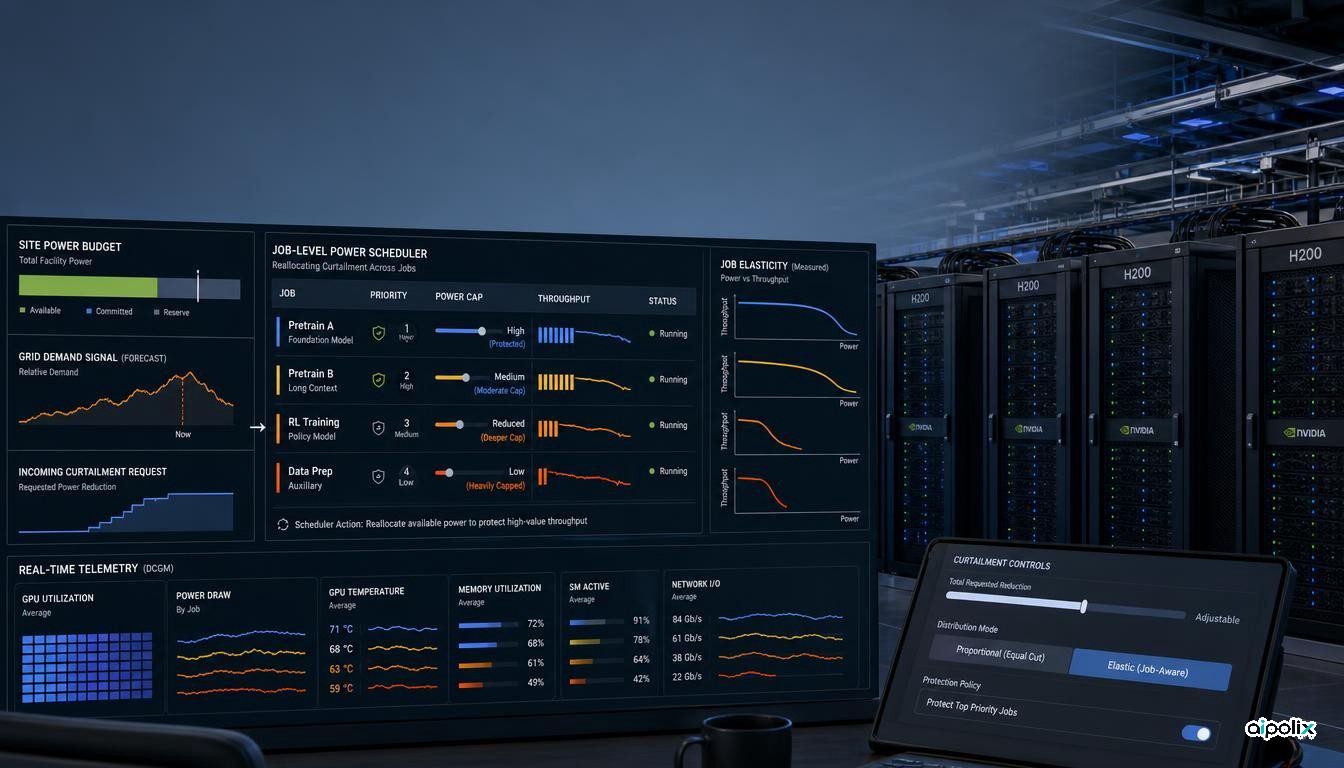
A new Emerald AI study argues that power flexibility in AI training should be treated as a property of individual jobs, not as a uniform capability of a GPU cluster. The researchers measured how throughput changes as GPU power is reduced across 131 H200 training runs, with 24 additional H200 validation runs and 34 matched H100 runs. They introduce a Power Flexibility Index, or PFI, intended to rank which jobs can absorb power cuts with the least performance loss.
That distinction matters as AI infrastructure increasingly encounters power constraints. A cluster operator that reduces every job by the same percentage can penalize workloads that are highly sensitive to lower power while leaving more flexible jobs underused as a source of demand response. The paper suggests that scheduling power reductions according to measured job elasticity can preserve more training throughput under a fixed cluster-wide power budget.
Power cuts do not affect every training job equally
The study covers dense and mixture-of-experts models, pretraining and fine-tuning, and clusters of up to 32 NVIDIA H200 GPUs. Across the H200 configurations, measured PFI values ranged from 1.10 to 2.67. The researchers found especially high flexibility in some mixture-of-experts fine-tuning jobs, while several dense pretraining and fine-tuning configurations were less tolerant of power reductions.
PFI is designed as a normalized measure of how much power can be reduced relative to the associated throughput loss. A higher value means a job gives up comparatively little throughput when its GPU power cap is lowered. The important engineering point is not the absolute score of one model. It is that jobs with similar nominal power draw can respond very differently to the same curtailment.
The authors also tested six matched job groups on H100 GPUs. The rank ordering was largely preserved, with a reported Spearman correlation of 0.943 between H100 and H200 measurements. They explicitly caution, however, that the H100 sample is too small to support broad generalization.
Telemetry may be enough to rank flexibility, but the predictor is still small
Running a full power-cap sweep for every production job would be operationally expensive, so the paper explores whether PFI can be estimated from ordinary GPU telemetry. The strongest simple predictor in the study was a feature based on DRAM activity and memory-copy utilization.
The resulting model is promising but still limited. It is trained on only 25 PFI samples derived from the 131 headline runs. Its leave-one-out R-squared is 0.524, while leave-one-cluster-out R-squared falls to 0.246. The authors say the dataset is too small to justify more complex predictive models.
That matters because a scheduler would rely on the ordering, not merely on an academic correlation. A misclassified inflexible job could receive a deeper power cut than intended and violate a throughput target. The paper's evidence supports PFI as a useful signal to investigate, not as a universal predictor already validated across arbitrary accelerators, training stacks and workloads.
Scheduling the cuts beats spreading them evenly in simulation
To test whether job-specific elasticity can improve cluster behavior, the researchers simulated 500 workloads with 100 jobs each. They compared several allocation strategies, including proportional power reduction, a PFI-aware strategy and an oracle with perfect knowledge of each job's complete power-performance curve.
In the simulated production-style mix, a 30% cluster power reduction produced the paper's headline result: PFI-aware allocation recovered about 1.5 thousand tokens per second per job relative to equal-weight allocation, closing 63% of the throughput gap between the equal strategy and the oracle.
This result should be read carefully. The scheduling experiment is a simulation built from the same measured power-throughput curves used to characterize the jobs. The authors explicitly leave closed-loop scheduler validation on out-of-sample workloads to future work. The study therefore demonstrates a plausible control advantage, not a proven production data-center gain.
The operational lesson is to curtail jobs, not just GPUs
Aipolix's analysis is that the most useful contribution is a change in how power-flexible AI infrastructure should be modeled. A facility-level promise such as "this cluster can shed 20% of power" hides the fact that the performance cost depends on which jobs are running at that moment.
A production scheduler could treat power flexibility as another job attribute alongside priority, deadline, GPU count and placement. During a grid event or site-level power cap, it could preferentially reduce power on jobs that have demonstrated lower throughput sensitivity while protecting jobs with steep performance loss.
This also changes how flexible-compute contracts should be specified. An operator should not promise curtailment capacity only from installed megawatts or GPU counts. The useful capacity is workload-dependent. It can vary as the training mix changes, which means the scheduler needs current telemetry and conservative fallback behavior when elasticity is uncertain.
The same logic argues against interpreting one PFI value as a permanent property of a model family. The paper shows sensitivity to task, scale and configuration, and its appendix notes that absolute PFI values depend on the power-cap sweep grid. PFI is more defensible as a measured job-level control signal than as a marketing label attached to a model.
Important limits keep the grid claim narrower than the headline
The experiments focus on H200 GPUs running on Google Cloud a3-ultragpu-8g nodes, with nvidia-smi -pl as the power-control mechanism. Runs cover pretraining and rank-32 LoRA fine-tuning for 30-minute intervals. The power accounting includes aggregate GPU power but excludes host CPUs, DRAM, networking, power supplies, fans and rack-level cooling.
Those exclusions are significant for grid-facing claims. A reduction in GPU board power is not identical to the reduction a utility sees at the meter. The relationship between the two can depend on cooling, power conversion, network activity and other facility loads.
The authors also acknowledge that their 25 PFI samples limit cross-architecture generalization. Their scheduling evaluation is simulated, and extensions to heterogeneous accelerators, reinforcement learning from human feedback, inference and closed-loop control remain future work.
The study is therefore strongest as an infrastructure-control result: AI training jobs have measurably different power elasticity, and that difference can potentially be used to allocate power constraints more intelligently. Turning that into dependable grid-responsive AI capacity still requires broader workloads, end-to-end facility measurement and live scheduler validation.