
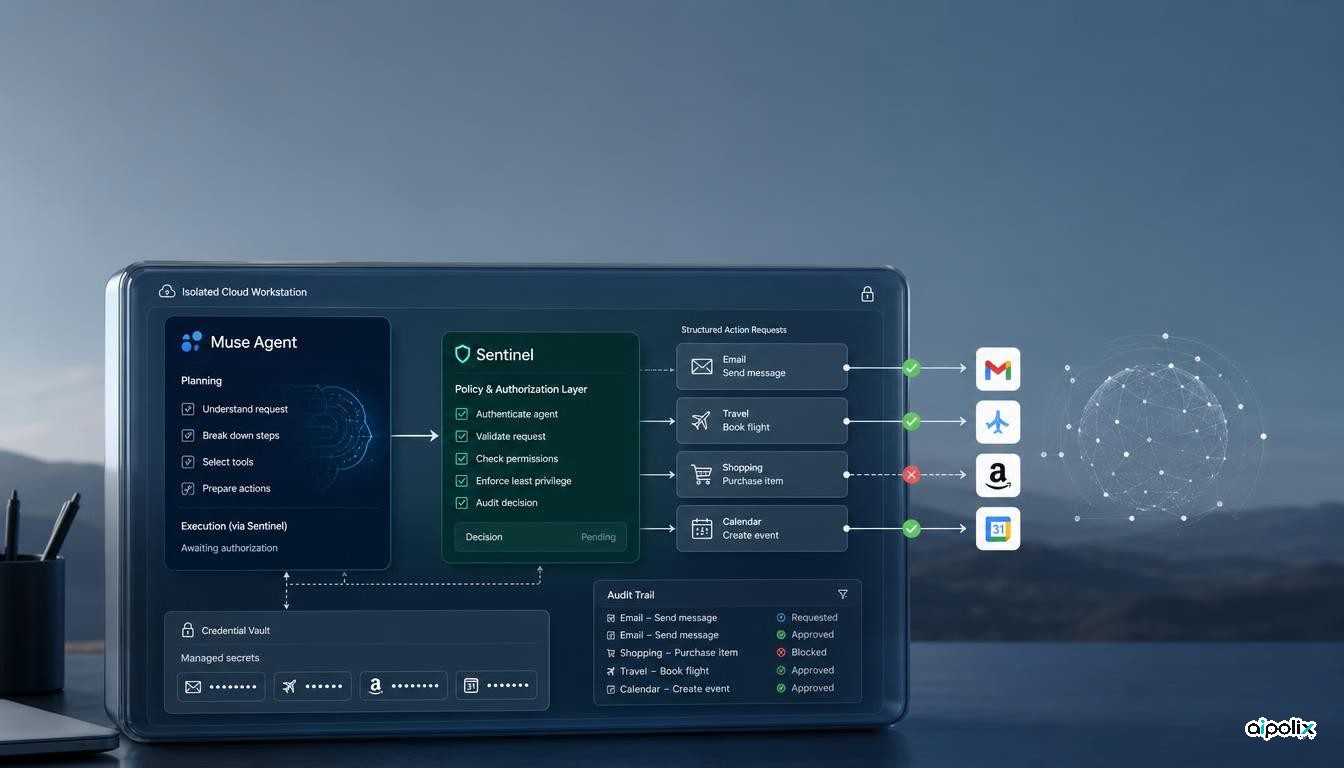
Meta has launched Muse, a personal AI agent designed to act across connected services rather than simply answer questions. The product can send messages, make bookings and work with other applications from a dedicated cloud environment. The more important architectural choice is that Meta does not let the task-performing agent decide alone whether an action may reach the outside world. A separate Sentinel agent is placed in the path and must approve outbound activity.
That separation makes Muse more than another assistant launch. It is a concrete example of an agent system in which execution and authorization are split into different components, creating a control boundary that engineering teams can inspect, test and govern.
A separate agent sits between Muse and the internet
Meta says each Muse runs inside a dedicated Muse Secure VM with its own browser. Connected credentials and data are kept in that environment. The company also says Sentinel is separated from Muse at the system level and that nothing Muse does reaches the internet unless Sentinel approves it, with user permission requested when needed.
This design matters because many agent systems place too much trust in the same model that interprets a request, chooses a tool and executes the action. If the model is manipulated by hostile content, prompt injection or an ambiguous instruction, the policy decision can fail for the same reason as the task decision.
Muse creates a second decision point. Sentinel does not automatically make the system safe, but it provides a distinct place to enforce rules before a consequential action crosses the boundary of the secure environment.
The useful pattern is authorization outside the acting agent
The Aipolix analysis is that Muse's strongest engineering contribution is not its task list. The important pattern is that the agent capable of acting is not also the final authority over whether the action is allowed.
That distinction resembles established security practice in which a workload requests an operation while a separate control evaluates identity, scope and policy. In an agent system, the same principle can reduce the number of decisions that depend entirely on one model's interpretation.
For teams building agents, this suggests a practical architecture. Tool calls that can send data, spend money, change records, contact people or reach external systems should pass through a separately governed authorization layer. That layer should receive enough context to judge the requested action but should not simply inherit every assumption made by the acting agent.
The key engineering question becomes what evidence Sentinel sees and how deterministic its policy is. If both agents rely on the same ambiguous context and the same failure modes, architectural separation alone is not sufficient.
Isolation does not remove the reliability problem
Reuters reports that Meta's internal testing found security and reliability problems before launch and that the company delayed Muse while strengthening protections. That independent context is important because it prevents the Secure VM and Sentinel design from being treated as proof that the risks are solved.
A dedicated VM can reduce cross-user exposure and contain credentials, while a separate gate can reduce unauthorized actions. Neither guarantee that an agent understands a user's intent correctly, resists every injection attempt or behaves consistently across complex websites.
Teams evaluating this pattern should therefore distinguish containment from correctness. Isolation can limit where a failure spreads. Authorization can stop some dangerous actions. Acceptance tests still need to examine whether the agent chose the right action in the first place.
Personal agents make auditability a product requirement
Muse is designed to remember user information and operate across services. That increases the value of an audit trail because the system's decisions can have consequences outside a chat session.
An effective agent record should show what the user requested, which tool or service was selected, what data was about to leave the secure boundary, what policy Sentinel applied, whether user confirmation was requested and what final action was executed. Without that chain, a separate safety agent can become an invisible policy layer that is difficult to debug.
The same requirement applies beyond consumer assistants. Enterprise agents that can approve expenses, update customer records, deploy code or query sensitive systems need reconstructable evidence for consequential actions.
What engineering teams should take from Muse
Muse should not be read as proof that one safety-agent pattern solves agent security. It is better understood as evidence that major agent products are moving toward explicit runtime control boundaries.
For developers, the useful takeaway is architectural: separate the component that proposes or performs an action from the component that authorizes its external effect. Then test that boundary independently, log its decisions and keep high-risk permissions narrow.
The launch is significant because Meta is putting this pattern into a consumer-facing agent rather than leaving it as an enterprise governance concept. Whether Sentinel proves robust in practice will depend on implementation details and real-world failure data, but the separation of acting and authorizing agents is already a concrete design choice worth watching.