
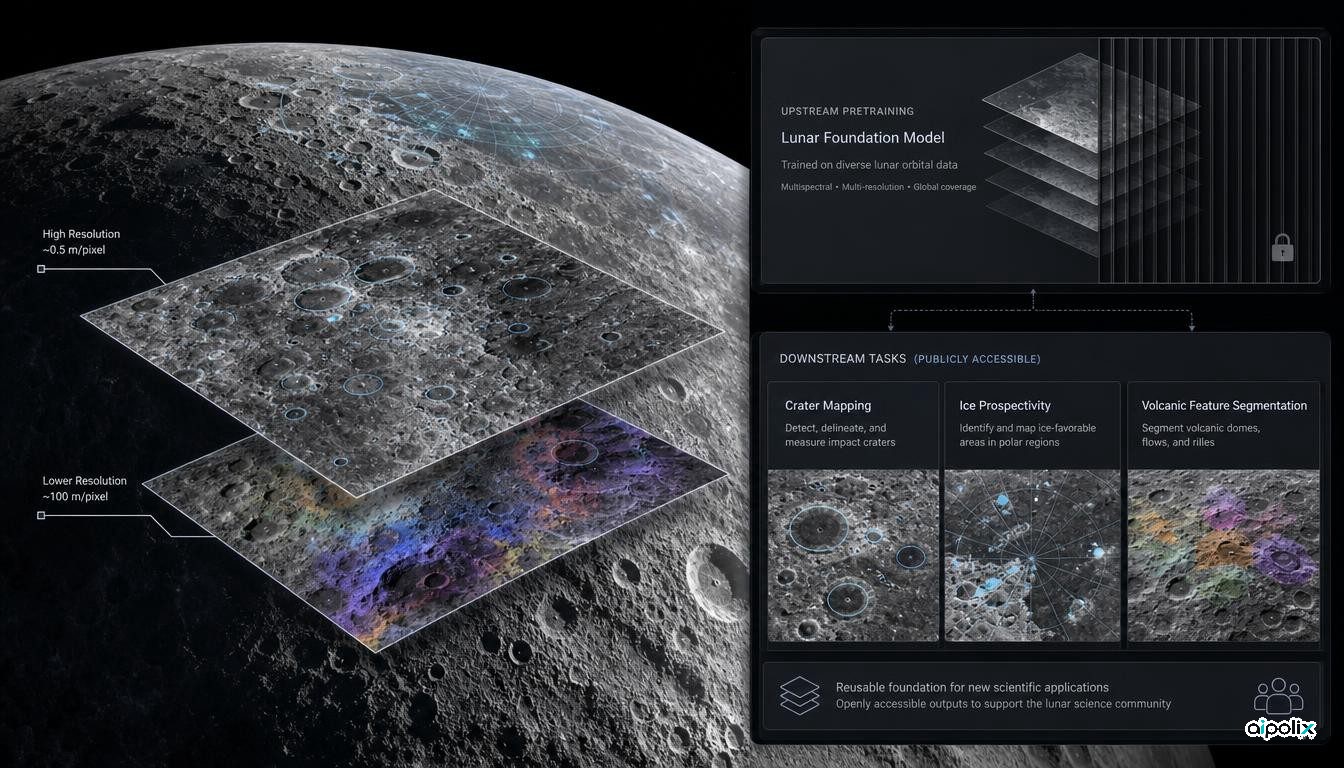
NASA and IBM have released the NASA-IBM Lunar Foundation Model, an open model built to work across several kinds and resolutions of lunar remote-sensing data. The release is more substantial than a model announcement: NASA says the team also published machine-learning-ready datasets and benchmark collections, while the project repository provides fine-tuning code and TerraTorch integrations for downstream tasks.
For researchers, the practical gain is a common pretrained representation for data that previously had to be aligned across instruments and spatial scales. But the release also has an important reproducibility boundary. The public GitHub repository explicitly says that pretraining code is not included. That means the open artifacts support inspection, inference and downstream adaptation much more directly than they support reproducing the original training pipeline from scratch.
A model built around the Moon's awkward data geometry
NASA says the model was trained primarily on data from the Lunar Reconnaissance Orbiter, using roughly two million image tiles. That includes more than one million high-resolution camera images at about one meter per pixel and nearly 964,000 multispectral images at about 100 meters per pixel, supplemented by data from other lunar missions.
The model card describes a ViT-B encoder-decoder trained on 11 modalities at two spatial scales. Two design choices are particularly relevant beyond lunar science. First, the model encodes acquisition geometry such as illumination angles instead of forcing the network to infer lighting effects from pixels alone. Second, it trains the high- and lower-resolution material together so one set of weights can be adapted across a roughly 100-fold resolution gap.
That architecture reflects a broader lesson for scientific foundation models: domain metadata can be part of the model input rather than treated as noise to be learned around. On the Moon, illumination geometry can dominate apparent surface variation. Encoding that known physical context reduces the burden on the model and makes the representation more aligned with how the observations were produced.
The benchmark headline hides uneven task results
IBM's announcement says the model can outperform widely used methods by as much as 23% on selected lunar mapping tasks. The underlying task cards show why that number should not be read as a universal performance gain.
For context-scale crater detection, the published checkpoint reports mean average precision of 0.2581, compared with 0.2420 for the strongest ImageNet-pretrained baseline listed there. At meter scale, however, the model's 0.1543 result is described as statistically indistinguishable from the top SwinV2-B baseline at 0.1552.
The ice-prospectivity task shows a clearer advantage. The task card reports RMSE of 0.0293 for full fine-tuning of the NASA-IBM model, versus 0.0377 for SwinV2-B on the eight-modality polar stack. These are useful results, but they remain task-specific benchmark outcomes rather than proof that one backbone is broadly superior for lunar science.
Open for adaptation is not the same as reproducible pretraining
The strongest part of the release is the downstream path. Weights and configuration are downloadable from Hugging Face, task checkpoints are published, and the GitHub repository contains a model package plus TerraTorch-compatible data modules, task wrappers and runnable configurations. A researcher can start from the pretrained backbone and evaluate or fine-tune it without rebuilding the entire data-processing stack.
The missing pretraining code changes what "open" means operationally. The repository is candid about the omission, so this is not a hidden defect. It is a boundary on reproducibility: an outside team can inspect the model and reproduce many adaptation experiments, but it cannot reconstruct the exact original pretraining procedure from the repository alone.
That distinction matters for scientific AI because the highest-cost and most consequential choices often happen before fine-tuning: data assembly, sampling, masking strategy, normalization, modality balancing and training schedules. Releasing weights and downstream code lowers the barrier to use; releasing the full pretraining path lowers the barrier to independent reconstruction and audit. The NASA-IBM project currently does the former more completely than the latter.
What the release changes for scientific AI teams
The model is still a meaningful infrastructure release. NASA says the project packages observations from multiple missions into machine-learning-ready resources, and the published artifacts give researchers a shared starting point for crater mapping, volcanic-feature segmentation and ice-prospectivity work. Reuters independently reported the release and its use in those lunar-analysis tasks.
For teams evaluating domain foundation models, the practical checklist is therefore two-part. First, ask whether the released backbone and task tooling reduce the cost of a real workflow. Here, the answer is clearly yes. Second, ask whether the release lets an independent group reproduce the claimed training process, not only consume the resulting checkpoint. For the NASA-IBM Lunar Foundation Model, that second answer is still incomplete.
The more interesting precedent is not that a general AI model can "understand the Moon." It is that a public scientific program has packaged difficult, heterogeneous observation data into a reusable model-and-dataset layer, while also making the remaining reproducibility boundary visible enough to audit.