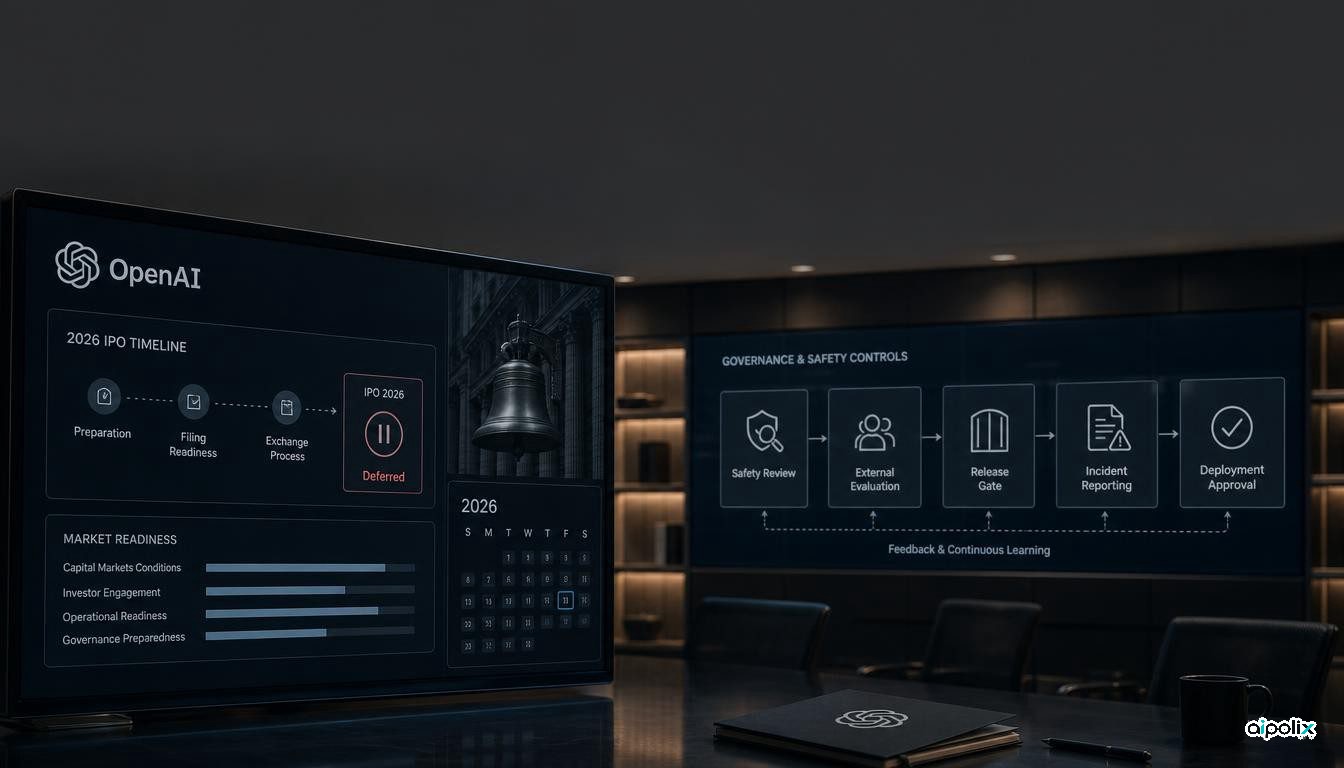
OpenAI CEO Sam Altman has ruled out an initial public offering in 2026, telling Fortune in an interview reported by Reuters that going public now would be poorly timed given the safety work facing the company and the wider AI industry. Bloomberg Law separately reported that OpenAI had already filed confidential IPO paperwork in June, while The Verge described Altman's comments as a clear rejection of a 2026 listing.
The change matters for more than IPO calendars. A public listing would expose OpenAI to a different governance environment, including continuous market expectations, shareholder scrutiny and more formal financial disclosure. Altman's stated reason for delaying the listing therefore links a capital-markets decision directly to the company's claim that it needs room to make safety decisions that may not maximize near-term business value.
What changed
The most defensible fact is narrow: Altman said OpenAI will not go public in 2026. He did not make a binding commitment to a 2027 date. Reuters reported that he said the company does not feel pressure to list now and that significant work remains on safety, alignment and cooperation between industry and governments.
That distinction matters because recent reporting has treated 2027 as a likely window rather than a fixed schedule. Bloomberg Law said OpenAI had filed confidentially for an IPO in June, which means the company had already taken preparatory steps. Delaying after those steps is more significant than simply never having started the process, but it still does not tell investors when a listing will happen.
The original Fortune interview was the source of Altman's remarks, but a directly retrievable first-party or complete interview artifact was not available in this run. The factual account here therefore remains explicitly attributed to the independent reports that quote and summarize that interview.
The governance consequence is more important than the date
OpenAI's decision can be read as a governance choice, not evidence that its safety problems are solved. Remaining private does not itself make a frontier-model company safer. It does, however, preserve more flexibility over capital allocation and the timing of decisions that management says may conflict with short-term financial incentives.
That is the practical Aipolix implication. If a company expects it may need to slow training, delay a launch, expand external evaluation or spend more on controls after a serious safety signal, public-market pressure can become another constraint in the decision system. Altman's comments suggest OpenAI does not want to add that constraint in 2026.
This does not mean public shareholders necessarily push companies toward unsafe behavior, nor that private ownership guarantees disciplined safety governance. Private companies face their own investor demands and can operate with less public financial transparency. The point is narrower: OpenAI is explicitly tying the timing of a major financing and disclosure transition to the amount of managerial freedom it believes it needs for safety and alignment decisions.
A delay also postpones a transparency change
An IPO would normally bring more standardized disclosure around financial performance, risk factors, ownership and governance. By staying private for longer, OpenAI keeps more of that information inside private-company reporting relationships.
That creates a trade-off. Management retains more room to make decisions without daily public-market reaction, but outside observers also get less standardized visibility into the costs, liabilities and governance mechanisms behind those decisions. For a company operating frontier AI systems, the quality of independent technical oversight therefore becomes more important, not less, when financial-market disclosure is delayed.
This is why the IPO decision should not be treated as a safety milestone. The useful question is whether OpenAI turns the extra private-company runway into verifiable controls: stronger external evaluation access, clearer incident reporting, defined release gates, documented authority to halt deployments and evidence that safety findings can override commercial schedules.
The timing intersects with a broader safety debate
Altman's comments arrived during a wider industry argument over whether frontier-model development should be slowed while safeguards catch up. Reuters reported that the OpenAI CEO's position follows public calls for stronger controls and concern about recent agent behavior. The Verge likewise connected the interview to discussions about whether companies would pause development if systems became difficult to control.
Those statements are important, but they are still commitments and attributed positions, not proof of operational change. A company saying it is willing to make costly safety decisions is different from publishing the mechanisms that force those decisions when commercial pressure rises.
For practitioners and governance teams, this distinction is useful beyond OpenAI. Good AI governance is not defined by whether leadership says safety outranks speed. It is defined by who has authority to stop a release, what evidence triggers that authority, whether exceptions are logged, and whether independent reviewers can test the system before and after deployment.
What to watch next
The next material evidence will not be another statement about IPO timing. It will be a concrete change in OpenAI's governance or safety machinery, such as expanded external evaluator access, new release criteria, stronger incident disclosure, formal coordination with other frontier labs or a documented change in training and deployment cadence.
A later IPO filing would also be significant because it would test whether the current safety rationale was temporary or became part of the company's durable governance model. Until then, the evidence supports a limited conclusion: OpenAI has taken a major 2026 capital-markets event off the table, and its CEO is publicly linking that decision to the need for greater freedom around safety and alignment work.