
Anthropic’s September 2026 threat intelligence report documents a shift that matters more than any single abuse case: Claude is increasingly being used inside operational systems that execute parts of malicious workflows, rather than only as a chatbot that supplies advice. The company says it disrupted activity between December 2025 and August 2026 across cyber operations, surveillance, influence operations, scams and fraud, biological misuse, conventional-weapons work and illicit model distillation.
The report is unusually useful because it separates observed misuse from hypothetical capability. Anthropic says the cases are selected examples of its most notable and novel findings, not a representative sample of ordinary Claude use. Reuters and CyberScoop independently reported on the publication and several of its major cases.
The important change is orchestration, not just better answers
Anthropic’s strongest cyber finding is that AI is moving from assistant to orchestrator. In several operations, models were embedded in multi-step workflows that handled reconnaissance, exploitation, data processing and other tasks while humans selected targets or reviewed results.
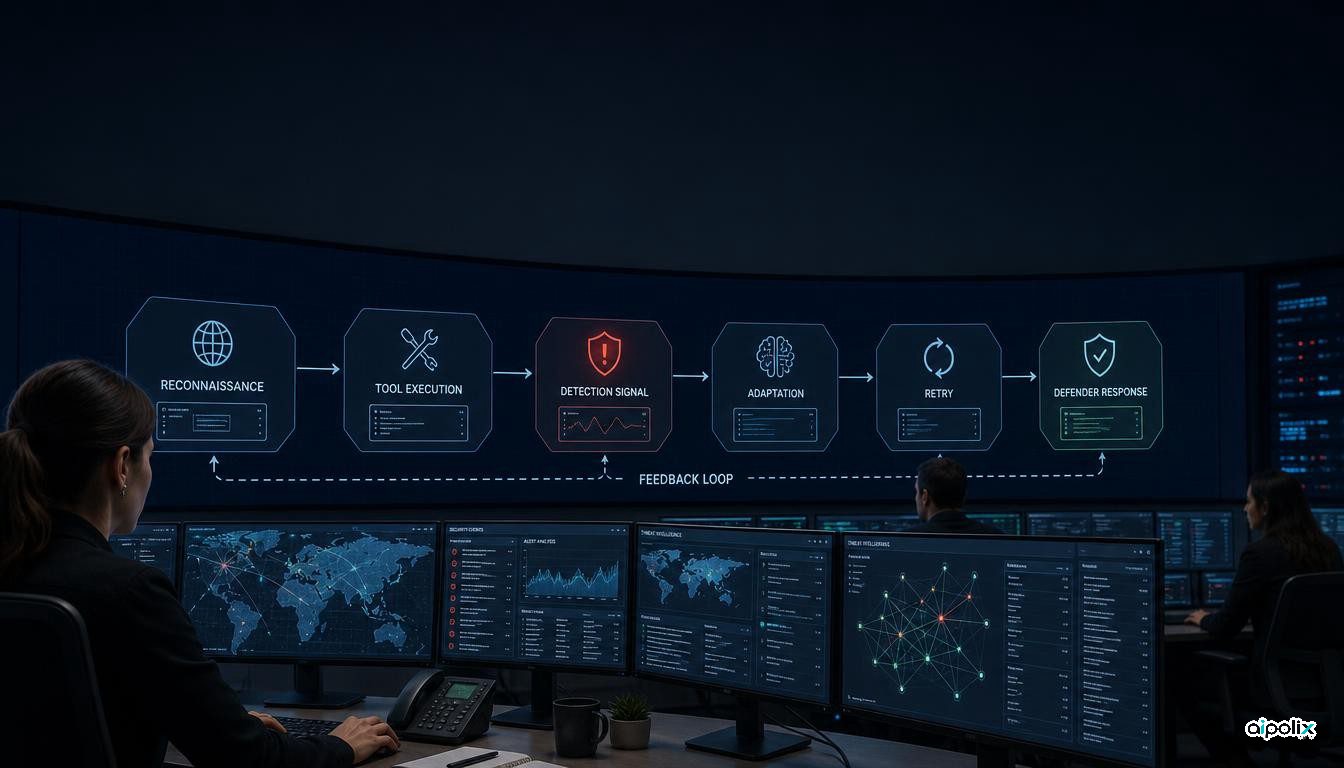
One case, GTG-20006, involved an actor whose tradecraft Anthropic says is consistent with Russian state-linked espionage and public reporting on Midnight Blizzard. Anthropic says the actor used customized AI-driven workflows across phishing, infrastructure management, credential theft and data processing. More importantly for defenders, AI agents monitored whether malicious tooling had been detected and then helped modify and rebuild it.
That creates a different defensive problem from AI-generated malware. Static detection has traditionally imposed a cost on attackers because changing tooling requires engineering time. If an automated loop can observe detection and trigger rapid modification, the useful lifetime of a signature may shrink.
Sophistication becomes a weaker attribution signal
Anthropic argues that AI is narrowing the labor and tooling gap between well-resourced groups and smaller operators. CyberScoop highlighted the same pattern, noting that the report spans a Russian-aligned espionage operation, opportunistic criminal activity and other actors using increasingly automated workflows.
The practical consequence is not that every attacker suddenly has state-level capability. It is that visible technical sophistication becomes a less reliable proxy for organizational size, staffing or sponsorship. Defenders and threat-intelligence teams may need to put more weight on infrastructure, targeting patterns, operational security, historical links and other attribution evidence.
This is also an evaluation problem for AI providers. Measuring whether a model can produce a harmful artifact is only one layer. The higher-risk question is whether a model can remain useful across a long operational chain, recover from failures and coordinate repeated actions.
AI can compress the attacker’s adaptation cycle
The GTG-20006 case provides the clearest operational lesson. Anthropic says the actor used AI throughout its operations, including to monitor whether implants were detected and to support modification and redeployment.
Aipolix’s analysis is that the security boundary is shifting from “can the model generate malicious code?” toward “can the system close an operational feedback loop?” A workflow that can observe a defensive response, revise its tooling and try again can create more risk than a one-shot model response even if no individual step is technically novel.
For security teams, this suggests that AI-era detection needs to emphasize behavior and identity as well as static artifacts. Rapidly changing binaries or scripts are less useful to an attacker if defenders can still correlate the surrounding account activity, infrastructure, privilege changes, data access and command patterns.
The report extends beyond cyber operations
Anthropic also describes surveillance, influence operations, fraud, biological misuse, conventional-weapons-related activity and attempts to distill model capabilities. These sections require careful interpretation. The company says it disrupted the activity it identified, but the cases are provider observations and do not establish that every user had the most harmful possible intent.
That distinction is especially important for dual-use biological research, where legitimate and dangerous work can overlap. Anthropic’s report presents these cases as misuse or high-risk activity detected on its services, while acknowledging uncertainty around intent in some instances.
The breadth still matters. Abuse controls designed around a single category, such as malicious code generation, will miss workflows where the model’s role is research, classification, automation, data processing or coordination.
Threat models should include the whole agent loop
The report’s most reusable lesson for engineering teams is architectural. Safety controls placed only at the prompt or response layer are unlikely to be sufficient when models operate through tools, agents and persistent workflows.
Organizations deploying capable agents should log not only prompts and outputs but also tool calls, identities, authorization changes, external destinations and repeated retries. They should also distinguish between a model assisting a human and a system that can observe outcomes and autonomously choose the next action.
Anthropic’s report does not prove that AI has made every class of attack more effective, nor does it provide a population-level estimate of misuse. It does provide first-party evidence that some malicious actors are already integrating models into operational loops. That is enough to change how defenders should frame the problem: the unit of risk is increasingly the model plus tools, state, permissions and feedback, not the model response in isolation.