AI systems that diagnose incidents are increasingly close to systems that can act on production infrastructure. A new preprint, GuardedAct, tests a narrower question: what happens if an AI-generated remediation is forced through a sandbox and a risk gate before it is allowed to touch the live system?
The authors report that, across five injected fault scenarios in the DeathStarBench social-network application, their framework recovered 87.4% of incidents and reduced collateral damage from 25.6% under direct LLM execution to 5.2%. That is a reported 79.7% reduction, with roughly eight seconds of additional mean recovery time from the sandbox step. These are preliminary results from a controlled benchmark, not evidence that autonomous remediation is safe in production. Still, the experiment makes an operational design choice unusually explicit: the model does not get the final say on whether its proposed action is executable.
The important change is where authority sits
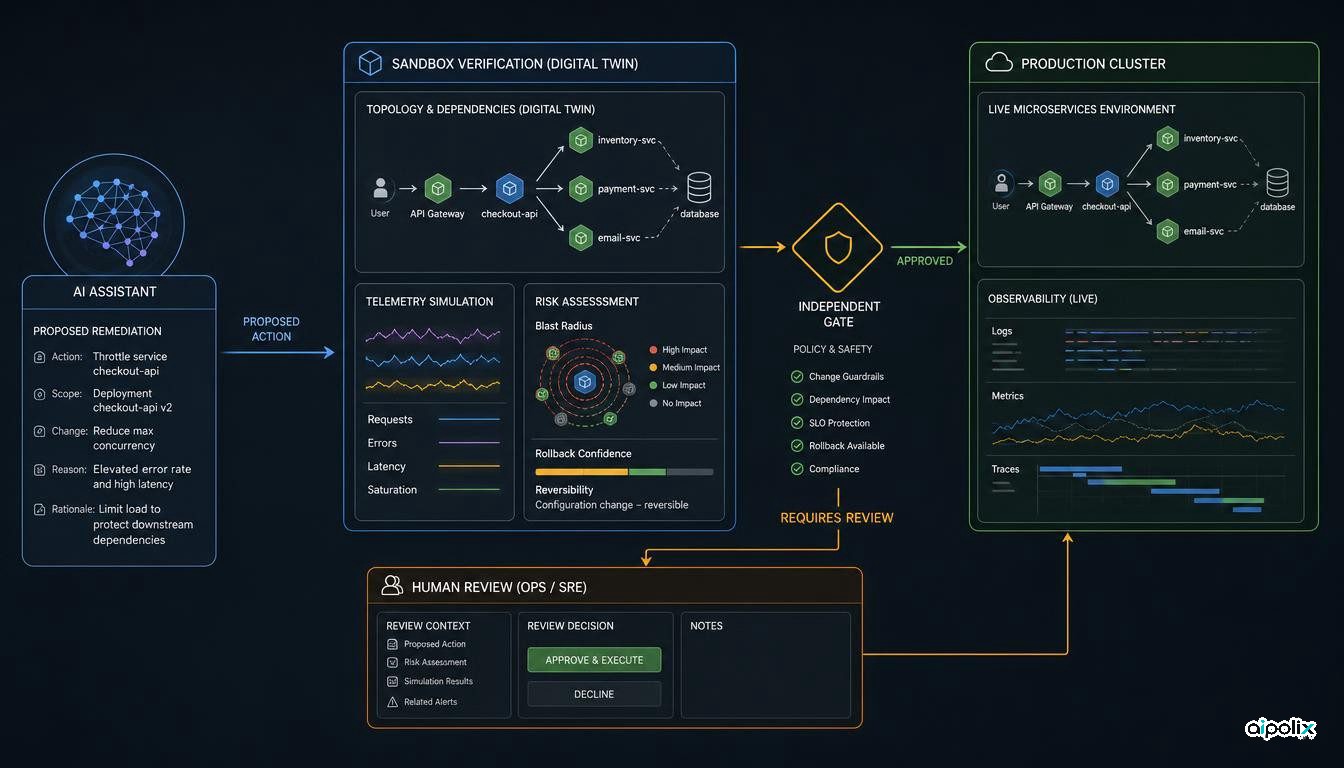
GuardedAct separates diagnosis and action generation from authorization. It first combines a diagnosis report with live topology and recent telemetry, then asks an LLM for a ranked set of candidate actions. Each action is simulated in a lightweight digital-twin environment, assigned a blast-radius estimate and risk label, and then passed through a rollback-confidence gate.
Only low-risk actions are eligible for automatic execution. Higher-risk actions are escalated for human review. In other words, the language model proposes a repair, but a separate mechanism decides whether the proposal is allowed to cross into production.
That boundary is more important than the specific model choice. If a remediation agent can both invent an action and authorize that action, then a prompt error, bad diagnosis, stale context or model hallucination can immediately become an infrastructure change. GuardedAct instead treats model output as an untrusted proposal that must survive an independent admission step.
The benchmark result is useful, but narrow
The paper evaluates five fault scenarios injected into DeathStarBench's social-network application, an open-source microservices benchmark. DeathStarBench is useful because it gives researchers a repeatable distributed application with realistic service interactions, but it is still a laboratory environment rather than a production estate with years of configuration drift, undocumented dependencies, noisy alerts and conflicting operator intent.
The authors report an overall recovery rate of 87.4%. They also report collateral damage falling from 25.6% with direct LLM execution to 5.2% with GuardedAct. The sandbox adds about eight seconds to mean recovery time. Those numbers make the safety-speed trade-off measurable, but they should not be generalized beyond the tested setup without further validation.
The most consequential limitation is the small scenario set. Five injected failures can show that the control mechanism behaves differently from direct execution, but they cannot establish how it performs across the long tail of production incidents. The preprint also does not establish that its digital twin can accurately represent every dependency or side effect that matters in a real environment.
A sandbox is only as good as its model of reality
The architecture introduces a second failure surface: the verification environment itself. If the sandbox has an incomplete topology, stale telemetry or an inaccurate model of a downstream dependency, a simulated action may look safe while the production action is not.
That means the operational requirement is not simply "put an agent in a sandbox." Teams would need to define what state is mirrored, how fresh that state must be, which effects cannot be simulated, and what confidence threshold is required before an action becomes eligible for automatic execution.
This is where the paper's blast-radius framing is useful. Instead of asking whether an agent is generally trustworthy, the system asks a narrower question about a specific proposed change: what could this action affect, and can the system roll it back with enough confidence? That turns safety from a model-level property into an execution-level admission decision.
The practical pattern is a policy boundary, not autonomous SRE
For engineering teams, the strongest takeaway is architectural. An AI remediation system should not inherit production authority merely because it can generate plausible commands. Proposal generation, risk assessment and execution authorization can be separated into different control layers.
That separation also improves auditability. A production record can capture the diagnosis, proposed actions, simulated effects, risk label, rollback estimate and final authorization decision. If the agent is later found to have reasoned incorrectly, operators can still determine whether the independent gate worked as designed.
The trade-off is latency and operational complexity. GuardedAct reports roughly eight seconds of additional mean recovery time. For many incidents, that delay may be acceptable if it prevents a damaging repair. For extremely latency-sensitive systems, the right policy may instead be to pre-authorize only a very narrow class of reversible actions and require humans for everything else.
GuardedAct does not prove that autonomous remediation is ready for production. It does provide a concrete test of a more defensible control model: let the agent recommend, let an independent mechanism estimate the consequences, and let execution authority depend on that evidence rather than on the model's confidence alone.