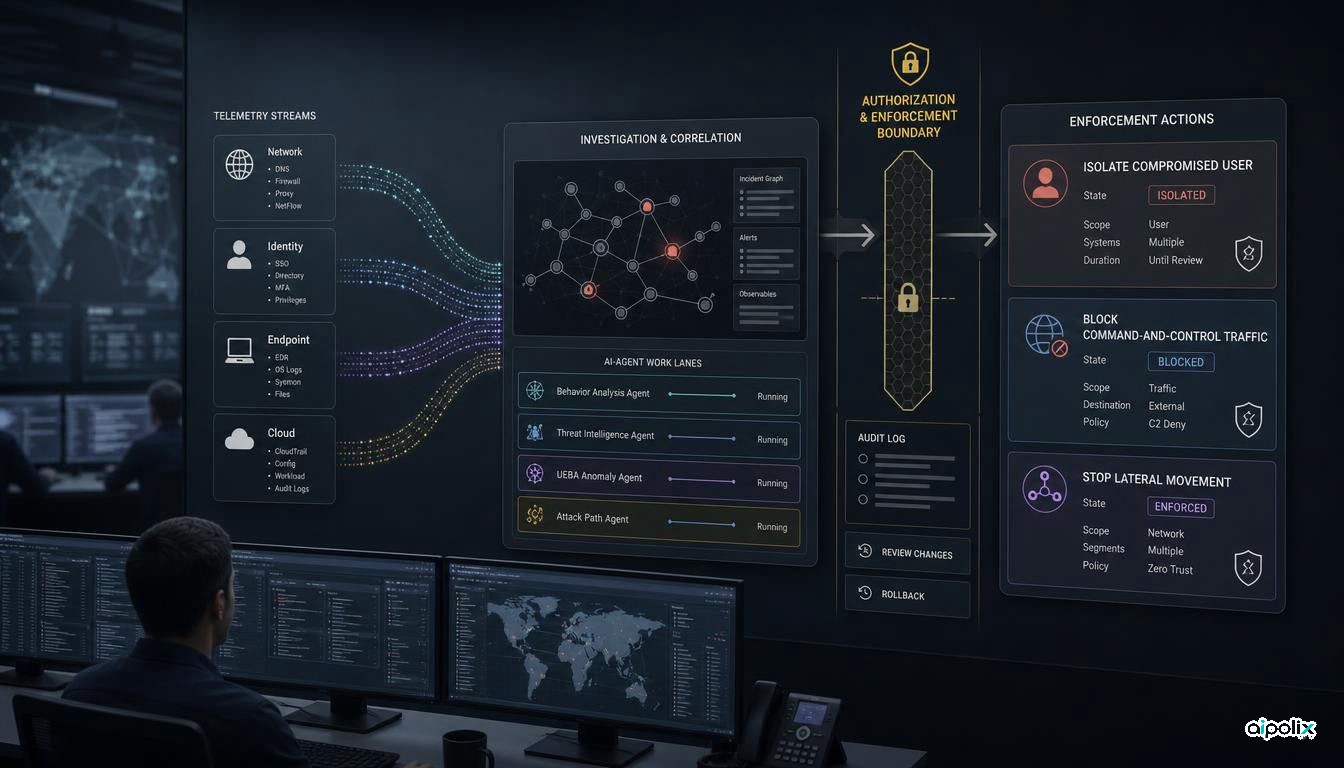
Zscaler has made Agentic SOC globally available, connecting specialized AI agents to the company’s inline security telemetry and Zero Trust controls. The product uses agents for triage, root-cause investigation, verdicts and response workflows, while Zscaler says its native controls can isolate compromised users, block command-and-control traffic and cut off lateral movement.
The important change is not simply that another security vendor has added agents. Agentic SOC places model-driven investigation on a path that can end in an enforcement action. That shortens the distance between an AI judgment and a consequential change to network access, which makes the control design around remediation at least as important as the quality of the model.
The agent loop now reaches enforcement
Zscaler’s September 9 announcement describes a context graph that combines its own telemetry with third-party data, then assigns specialized agents to investigation tasks. The company says those agents can trigger response workflows and use inline controls to contain threats. Its fiscal 2026 Form 10-K, filed on September 3, had already described Agentic SOC as a product that centralizes alerts and uses AI agents to triage, investigate and respond.
That filing matters because it confirms the product and its intended role outside the launch-day marketing narrative. The September 9 change is availability: Zscaler says Agentic SOC is now available globally.
The strongest claims about speed, accuracy, effectiveness and the scale of the telemetry remain vendor claims. Zscaler’s own forward-looking-statement section explicitly says expected performance, adoption and benefits may differ from current expectations. Those claims should therefore be tested in customer environments rather than treated as established outcomes.
Closed-loop remediation changes the failure model
A security assistant that only summarizes evidence can be wrong without immediately changing the environment. A system that can isolate a user or block traffic has a different failure mode. A false positive can become an operational interruption, while an incomplete investigation can cause the wrong containment action to be applied.
That does not argue against automation. It changes what needs to be governed. The remediation path should have an explicit policy boundary that defines which actions may be automatic, which require human approval and which evidence must be present before an action is allowed.
For example, blocking a known command-and-control destination may justify a different approval threshold from disabling a privileged employee account. Treating both as generic “response actions” hides the difference in blast radius.
The useful architecture is bounded autonomy
The Aipolix analysis is that Agentic SOC should be evaluated as a bounded-autonomy system, not just as an AI analyst. The relevant design question is where the agent’s authority ends.
A production implementation should be able to answer four questions for every automated containment action: what evidence led to the verdict, which agent or rule requested the action, which policy authorized it, and how the action can be reversed. Those records should survive beyond the conversational or investigation interface.
This is especially important when multiple agents contribute to the same case. A root-cause agent may reach one conclusion, a verdict agent may assign severity, and a response agent may choose the containment step. If the system only logs the final action, operators lose the causal chain needed to audit an error.
Third-party controls widen the trust boundary
Zscaler says Agentic SOC can use both native controls and customers’ third-party tooling. That increases flexibility, but it also expands the authorization surface.
A response sent through a Zscaler-native control can potentially use one identity, permission model and audit trail, while an action sent to an endpoint, identity or cloud platform may depend on another. The agent layer therefore needs narrowly scoped credentials and action-specific permissions rather than broad administrative access inherited from an integration account.
The same principle applies to model providers. Zscaler says it works with frontier models from Anthropic and OpenAI alongside proprietary threat intelligence. Model choice is relevant, but the enforcement boundary should not depend on a model being perfectly reliable. Policy, identity and permission checks need to remain outside the model’s discretion.
What security teams should test
Before enabling automatic remediation, teams should test the system with cases where evidence is incomplete, contradictory or deliberately misleading. Useful tests include whether a benign administrative tool can be mistaken for attacker activity, whether one poisoned data source can dominate the context graph, and whether a response can be rolled back cleanly after a false positive.
Teams should also separate evaluation of detection quality from evaluation of action safety. A system may classify incidents well while still choosing overly disruptive remediation. Those are different measurements and should have different release gates.
Finally, operators should measure how much human review is actually removed. Faster triage is useful, but the operational value depends on whether the agent reduces analyst work without creating a new queue of approvals, reversals and exception handling.
Agentic SOC is worth watching because it moves agents from analysis into the security enforcement path. The durable engineering lesson is not that “AI can run a SOC.” It is that once an agent can change access or connectivity, its permissions, evidence trail, rollback path and escalation rules become first-class security controls.